The Signs of God


July 24, 2016   The Tenth Sunday after Pentecost     Luke 11:1-13

Q team

Last Tuesday I spent the day on the Chesapeake Bay with eight others fishing for cobia. This is a fine eating fish; they come big and fight hard. We went out early and stayed for two tide changes.

After three hours of watching the tips of the rods not move, enjoying the banter of fishermen, and getting hungry, I decided this was the time and place to bring God onto the scene. I told them I would say grace over our lunch and also would address the One who gave us the food, asking Him to show cobia where they could find a snack. I might have even said, “…where they can get hooked on a snack.”

Later, within an hour of our time to head in, we landed two large cobia.

Was that a “sign of God”? Certainly to the woman on board, a friend who is applying to Anglican Frontier Missions. Probably to the others as well. There was talk among them of the Lord sending “seconds”.

But we know that quantifying answers to prayer is difficult, not because the answers aren’t there but because God’s answers are not always so obvious as “fish on line”.

In the sphere of missions there is a place for seeing signs of God. The best quote for this comes from Prior Roger Schutz of the Taizé Community. He wrote in 1960, “Les chiffres sont les signes de Dieu.” Or, “Statistics are the signs of God.”

William Carey knew the importance of statistics for mission work. He wrote a pamphlet commonly known as “An Enquiry into the obligations of Christians to use means for the conversion of the Heathens.” The title continues in smaller type: “In which the religious state of the different nations of the world, the success of former undertakings, and the practicability of further undertakings are considered.” Then he gives 23 pages of tables by continent of the religious state, the former undertakings, and the relative success of these efforts. Carey knew statistics tell the tale.

World Christian Trends 

WCT shows us ways to discern the signs of God, how to sight trends.  The pattern is the same for international missions as for local church. We build upon an irreproachable mandate, use reliable sources, and then find valued analysis.

The Mandate:             WCT lists 23 verbs from our Lord and throughout the Bible that urge measuring by numbers. A sample of these are: Add (Acts 2:41); calculate (Luke 14:28); count Rev. 11:1); list (1 Tim 5:9); measure (Rev. 11:1); survey (Josh 18:6); register (Luke 2:1). From this list come another 51 English imperatives related to what WCT calls missiometrics.

Clearly, God leads us into the dimension of records. How can we know what God is doing, after all, if we cannot see the before and after?

Reliable Sources:        As much as this exercise applies to the task of world evangelization, we also must apply the same principles to leadership in the local church.

Listed first in “50 new facts and figures about trends” is this statement:
“Every year the churches hold a megacensus costing $1.1 billion, sending out 10 million questionnaires in 3,000 languages, which covers 180 major religious subjects.”

The categories for these reports are not randomly chosen. They plunge into the realities of church life. Is there growth in attendance? Is growth by birth or conversion? What ages are leaving, what ages joining? And more, many more areas to be examined.

Who reads these? Maybe your bishop or Superintendent, maybe not. But researchers do. They pore over the findings, study the documents, and track the changes.

Major missionary organizations also carry extensive databases. Some of these are:
Summer Institute of Linguistics for Bible translations (http://www.sil.org/linguistics);
Joshua Project (https://joshuaproject.net/index.php);
Global Prayer Project (http://www.globalprayerdigest.org);
World Christian Database (http://worldchristiandatabase.org/wcd/);
Operation World (http://www.operationworld.org).

In addition to these religious surveys are the extensive reports of the United Nations (UN) and United Nations Education Scientific and Cultural Organization (UNESCO).

In one major section, WCT carries 171 columns of data for each country. The data come from reports of these and other organizations. The lengthy composite reveals quality of life in several key areas, the strength and needs of the church, and key steps towards evangelization. The columns for your church reports also give composites, composites that show strength, gaps, needs, and more. Wise leaders will push for understanding, then push more for reasons, and push again for what to do and where.

Valued Analysis:         Actually the analysis comes in pages and tables of the book; the value must come from the student of these figures.

For instance, planning for work in Cambodia will examine life there. show that only 13 % have access to clean water. There are only 12 hospital beds per 10,000 people.  Cambodia has 40,000 blind people and 672,000 deaf. The country has a very high murder rate of 70 for every 100,000 people. Results of this study must determine the shape of ministry there in the name of the love of Jesus Christ.

The benefits of studying the signs of God through statistics can prevent errors all too common in the church. I will mention three:

Duplication.     This is the arrogance that my particular ministry is so far superior to another’s that I must pursue my effort as if other efforts do not count and are not there.

Neglect.          Evangelization of an ethnic group or a city requires multiple layers. Studying the trends as represented in books like WCT will highlight needs that have been overlooked. In Cambodia, for instance, these numbers reveal the deeper picture of poverty of respect for life.

Hunch.             Factors that determine emphasis in ministry can be less than honorable. Some may be the particular likes or dislikes of the leader, ministries popular with donors, or where the glitz—the photos, the stats, “the bang for the buck”–is greatest. The counterparts of these fit easily into ministry in the local church, do they not?

Before we scoff at studying statistics to discern trends, we should recognize how statistics serve this purpose in other spheres.  During the recent All Star Baseball game in the US, with each batter the TV screen showed layers of statistics to tell us what we might expect him to do. Watching a golf tournament now gives the viewer the exact length of the putt and the % for that golfer on that putt.

Next week: a composite of Turkey—its government, churches, demographics, and society.


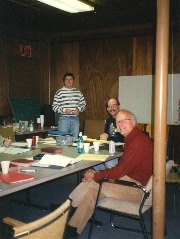
Photo: Part of a team researching one of the large unreached peoples, in preparation for devising strategies.


Posted in Gentile nations | Leave a comment

Mary, Martha, and Missions

The Ninth Sunday in Pentecost, July 17, 2016   Luke 10:38-42

Just as I was getting ready to launch Anglican Frontier Missions back in 1993, one of my mentors said, in passing, “You know, God has done great things in the world… in spite of the missionaries.”dominos in Indonesia

This man is not at all against sending missionaries. Quite the contrary, he has sent many, became one himself, and has written about missionary practices. One of his books I highly recommend and mention at the bottom1. While he is a missionary advocate, he has sat with Mary at the Lord’s feet.

That is first work of any Christian worker–to sit beside Mary at the feet of Jesus. Martha has her jobs, but the better—and more crucial—is Mary’s. Henry Blackaby gives us this provocative statement from Experiencing God: “Don’t just do something. Stand there!”

In Paul’s letter to the Colossian church, which is read over four Sundays, he gives high praise to the life of this congregation—for their hope, faith, and love; for their witness to surrounding cities; for their resistance to distortions to the truth; and for their earnestness in prayer.

In the letter he points to the origins of their maturity—a man named Epaphras. We have enough of a description of him to see in his life the priority of Mary’s devotion and the fruit of Martha’ toil.

Love                 He lived among them, sent Paul news about their growth in the Lord, committed his heart to seeing Christ be born and take root in them. Paul could mention the love of the Colossians certainly because they had a leader whose love was their model and example.

Prayer              He “labored in prayer.” That’s not emphatic enough for Paul. “He labored fervently for you all.” Epaphras was a man whose walking and talking with them were essentially prayer walks and prayer talks, increasing and informing his labors of intercession.

Zeal                 As Epaphras saw his Lord and Master, Jesus Christ, he saw whom he wanted to be recreated in the people of Colossae. Paul referred to him as a “fellow servant” and “faithful minister”—a pastor’s heart and soul bound up in his efforts to teach, admonish, lead, and form the Body of Christ.

Sacrifice          The one specific example that Paul gives of his friend occurs at the close of the letter when he wrote Philemon, written at the same time he wrote this letter. “Epaphras, my fellow prisoner, greets you (Phile 23).” There is exposed the life of a man who knew “the better thing” and did not fail to do the work God gave him.

We find one supreme and rare compliment to the fruit of the labors of Epaphras. This Body of Christ was so rich that many of Paul’s friends went out of their way to stop in. These knew that a visit to the Colossian church was one they would cherish, that the friendships were lasting and deep, and the fellowship in Christ had splendors of heaven. Among the visitors were Tychicus, Onesimus, Aristarchus, Demas, Luke, Mark, Justus, Archippus, and Nympha. A supreme and rare tribute, indeed.

World Christian Trends

The work of mission is the work of both Martha and Mary. But it starts with Mary. And that “better thing” must include prayer.

Keith Carey has led the ministry of the Global Prayer Digest for 30 years. This monthly digest gives information on the least evangelized ethnic groups for prayer2. Recently Carey wrote that the number of unreached groups 30 years ago was about 17,000. That number has now been reduced to about 7,000. Why? Because prayer moves God. Yes, there are many angles that can dissect that statement, but at the end the truth remains: God has heard and answered prayer!

At the same time God expects us to use our brains, our imagination, and our resources. Jesus did not imply that Martha’s work was frivolous. The commission to evangelize the world requires the best that we can offer.

WCT presents the gallery of strategies for world evangelization. It lists 1500 of them, noting that there are more. (One that does not make the list, mentioned in the corridors of our offices [theirs were just above ours] was the plan to send television sets by parachutes over the Himalaya mountains.)

The list begins with Matthew 25:18, what is called The Great Commission. Number 63 comes in the year 1000, number 93 at 1500. Two-thirds of them have come since 1960, with about one a month since 1990.

Ours would have come in 1985 under the plan of the Southern Baptist Foreign Mission Board with what was then called the “non-residential missionary.” We piggy-backed shamelessly on their advanced planning.

In the analysis of these plans, WCT points out the basic elements of the most enduring plans, the most common flaws, and the goals to seek.

The most basic elements:
Evangelization            There is no short cut in this. Incarnational love, language learning, and time are built into this.
Cooperation                My hunch is that the reason the Lord urged unity in His High Priestly prayer of John 17 is that that reality is so difficult for us. This cooperation means cultures, races, denominations, confessions, and genders see greater value in working together than separately.
World A                       This is the term for those ethnic groups that are less than 50% evangelized. Along with this piece comes the recognition of the essential reliance on research, statistics, and numbers. If illiteracy means those who do not read, innumeracy means those who do not value these tools
Wholism                      “Evangelization requires word, sign, and deed inseparably linked. This includes a response to justice, peace, and responsibility towards creation and the truth of the Gospel to all areas of human experience.”

The most common reasons for failure are:
Organizational isolation
Financial mismanagement
Downplaying the cost of discipleship
Moral lapses
Rigid church/mission structures
Excessive dominance of Western churches
Spiritual flabbiness
And about 325 others.

The goals for mission      by the year 2025     projected status at today’s pace:
Global % evangelized             100%                           77%
# of cities without a
church                                     0                                  80
# of people groups
without a church                       0                                  500
# of languages without
a Bible                                     0                                  4,000
% of giving to Christian
causes                                     3%                               2%
% of population Christian        44%                             33.4%


Photo: Lampung men of Sumatra, Indonesia, enjoying a (regular?) afternoon’s game of dominoes.
Posted in Gentile nations | Leave a comment

The Good Samaritan — Profiled

The Eighth Sunday after Pentecost, July 10, 2016  Luke 10:25-37

After the Samaritan left the inn where the man was recovering, there were a few comments heard inside.

“Do you think his money is any good?”

“Who does he think he is, coming in this establishment like that?”

“Anybody want to take bets that he does not come back tomorrow?”

Profiling gives credibility to stereotypes, which, in turn, render the person in the least favorable light. Profiling diminishes the person to the lowest expectations. At best it doubts respect, and at worst, it abolishes any spot of honor, worth, and dignity.

Profiling puts filters into the person’s hands through which he or she views the world The filters, of course, eliminate certain characteristics, whether they are there or not.

In the mission work of the church and much of its international life, the residue of time gone by has left filters in the hands of some, and these some are mainly white Anglos. The reasons go back to the past two hundred years when most Christians were white and most of the pioneering missionaries of that era were also white.

Holding these filters today removes from sight the changes in God’s fields. I’ll just mention a couple. Two of the liveliest Anglican congregations in the Ukraine and in the United Kingdom are led by Nigerians. in India the surge of growth of the church can be traced back to the great Bishop Azariah. At the Edinburgh Missions Conference of 1910, he told the assembly, “Do come to India, but come as friends. India will be evangelized by Indians.”

The residue of the past two centuries firmly established the footholds for these filters, so they have disappeared slowly. My formal education reflects this. It lasted between the years 1949 and 1969. In those 20 years I had no more than two years of schooling with girls. There were no “people of color”—of any color other than white—but for a small number enough to be counted. As for religion, I grew up in a family of 9 other Episcopal clergy in my immediate family. My hands were full of filters!

It is a euphemism to say that “exposure to others” helps us see better. It takes cracks in our pride, direct hits, for us to receive God’s grace that allows a wider vision of His world and the people He loves. The lesson is an easy one to identify—to grasp the profiles that God designs.

World Christian Trends

When profiling rears its very ugly head in the church, the lamentable result is diminishing God, overlooking His people, forgetting what He is doing, and replacing all that with a serious myopia that leaves the world out of sight. We must gain the vision that sees God at work.

I bring to your attention the church in two countries—Brazil and China: Brazil because the world sees that country only in turmoil and not what God has established there; China because its church is one of the largest in the world, as is the nation itself.  Overlooking China only shows our myopia.  (Can you remember the name of China’s Prime Minister? Do you know how to pronounce his name?)  The statistics on these two countries are eye-opening.

First, Brazil.  Just consider the size of its two largest cities: Sao Paulo has 10 million, Rio de Janeiro has 17 million people. In Christianized countries, the population of Brazil will be second only to the United States in 2025 with an estimated population of 217,930,000

In 1900 Brazil was the 10th largest church in the world with 17,319,000 believers. By 2000 the. church had swollen to 155,545,000. Among Pentecostal/charismatics, they lead all countries with almost 80 million. That represents 47% of the church.

Among the ethnic peoples, the Branco Brazilians are the largest Christian ethnic group, with just over 80 million. The 7th largest Christian group is the Mulato Brazilians, numbering 35 million.

There is more going on in Brazil than the Olympics.

China has firsts in enviable categories as well as some less.

China is the largest country by population, with 1,460,000,000 projected in 2025. After India, China has the most cities over 50,000 – 463.  The nation has 254 different ethnic groups, many with subgroups that speak dialects unintelligible to others in the same ethnic group. It also ranks second to India with the number of blind, deaf, and lepers.

The church has reaped the fruit of the tears, the prayers, and the martyrs and missionaries of the 19th and 20th centuries. In the last decade of the 20thcentury the church was estimated to be increasing by one million people per month. By 2025 it is estimated that the number of Christians will number over 135 million, just after the churches of the United States and Brazil.

The predominate affiliation is categorized as Independents. This reflects the strength of the House Church movement. The Chinese church is second only to the United States with the number of Great Commission Christians, 81 million.

An interesting insight into the enormity of the population of China comes with the Han people. There are 810 million Han. These must be divided into numerous subgroups. Among the Han groups are the Mandarin Han, the fourth largest Christian group with 61 million. But there are three Han subgroups among the largest unreached peoples. These are the Jinyu (47 million), the Hunanese (44 million), and the Kan (25 million).

As might be expected with a nation of this size and with the growth of the church being so recent, the needs for the church’s work are clear. These same Han groups are among the largest ethnic groups without the printed Gospels, much less the entire Scripture. The Jinyu have lacked a mission agency as recently as 2000.

In my appreciation for the 4th of July and the United States’ unique history, I have been reading Alexis de Tocqueville on Democracy in America. His wisdom and insights make it clear how well we have molded ourselves and society around the pillars of democracy. Reading him also makes it crystal clear that expecting democracy to appear and flourish in China as it has here is unreasonable. The manifestation of the influence of the Body of Christ in China will have its own distinct and very powerful shape.


Photo: Dai women in Yunnan Province, China, with their first blue chewing gum! It broke the ice.
Posted in Gentile nations | Leave a comment